
Q&A with Katie Baxter
1) What specific goals/actions would you take to address the affordable housing crisis in our communities?
About the crisis:
There is a housing crisis in our state and specific community because we are in a perfect storm of economic realities that burden people striving to put an affordable roof over their heads. The realities experienced across the Commonwealth as well as in Scituate include:
• An increasing number of people who simply are not making the liveable wage required to meet the rising costs of rent and home prices;
• The State has yet to strategically provide a comprehensive range of options for managing housing production costs so that our housing market offers the right type of housing at the right stage of life and circumstances;
• Concerns over rent-stabilization efforts continue to stall progress in finding ways to realistically address ongoing issues such as - developer's and real-estate associations' objections, maintenance and repair costs, as well as controversies between private real estate investments and keeping rents within the tenant's ideal rent-to-income ratio;
• In towns like Scituate, its Housing Production Plan data shows that rental properties are not seen as economically advantageous by developers. This means that more units-to-be-owned versus units-to-be-rented are being proposed. In many cases towns end up with a shortage of desirable apartment units.
• Suitable land for housing development is scarce in 4th Plymouth because of the topography, soil conditions, water resource areas and zoning and regulations in place to protect town clean drinking water and stormwater systems. This land scarcity creates extreme high market values for vacant lots. In turn developers are making high-cost project investments in order to make a high profit, and these costs are passed on to their customers.
About the state representative's role: As your state representative my role would be to work with the local town officials, boards, committees and constituents to identify the disconnects that naturally occur when statewide bodies such as the legislature or executive agencies are intent on solving big picture challenges. I would represent municipal level concerns to state committees, lobbyists, legislators and leadership on Beacon Hill to ensure that an approach of one-size-fits-all housing reforms does not enforce mandates on our communities. We have seen locally that state mandates can, in their implementation, have the unintended consequences of altering towns' unique characteristics, corroding local infrastructure, and creating a new set of high cost items. Constituents do not welcome state mandates. They want tools, reasonable implementation timeframes and local aid funding that will empower them to make the far-reaching, long-lasting decisions for integrated growth of things like housing production, transportation and local businesses.
My specific district focus on Goals/Actions for addressing the affordable housing crisis in our communities:
• Craft wording for legislation that strikes a balance between the growing friction between individual's property rights and the community's rights to public health and safety
• Protect civil rights and fair housing so that equitable opportunity to remain in a town where you were raised or you raised your family can be met
• Work with the town administrators to craft amendments to proposed housing legislation that would strengthen a bill's practicality and relevance at the local level
• Become a member of the Coalition to End Homelessness that State Representatives Joan Meschino and James Hawkins founded years ago to create a think tank of regional and local solutions to the Plymouth and Bristol County districts
• Attend the briefings and participate in the hearings of the legislature's Joint Housing Committee to forge a productive communication channel between our district and House members and leaders so that when we need boots-on-the-ground attention to our issues we have already opened the doors to fruitful communication and strategies based on collaborative solutions-building that our towns need
• Tenaciously advocate for funding to accommodate what comes with housing production growth: expanded water and sewer treatment needs and waste management; upgraded roads, intersections, bike lanes and sidewalks; innovative stormwater management; expanded energy grids, public facilities and open space maintenance, increased local public transit options delivered by vendors such as Gatra, etc.
• Work with the legislative members of the Plymouth County to determine how the State Land for Homes Initiative can help our towns provide specific regional, campus-like housing with wrap-around services to increase transitional housing needs, veterans housing, aging-in-place housing, etc.
• Create opportunity for local planning to keep its Housing Production Plan on the front burner so that developers look at available land with an eye to creating purchase options- small starter homes for families; accessory dwelling units outfitted with features for aging in place; modest homes with designs that both fit into neighborhoods and will not become a financial burden on homeowners when unforeseen economic downturns hit, etc.
2) How do you plan to engage with your constituents to learn about what their top priorities and concerns are?
My style of representation is relational versus transactional. Throughout our district I have heard directly from voters that there is an undercurrent of discontent born out of a feeling that their vote has become a politician's commodity to be counted as a transaction rather than as an expression of trust and shared commitment in preserving democracy, collaborating on solutions, and creating accountability. As your representative I will bring an unwavering commitment to show up as a community participant and legislative leader to listen to your concerns, ask about your priorities and involve you in the policymaking process so that we are partners (active partners, not silent or occasional) in the actions of forging solutions for a thriving community. In my experience as a library administrator/consultant, educator, legislative aide, I found using a combination of engagement tools and responsiveness builds deep and effective communication channels with individuals, small groups and larger bodies of participants. As your representative I would work with my legislative aide, interns and in-district volunteers to create a cohesive approach so that constituents and local officials can trust that I am invested and attentive to working on their concerns. I envision using the following forms of engagement in my office to restore and reinvigorate our district's trust in the communication channels that bring community together and empower each other to participate in democracy:
• Constituent service hours regularly scheduled at public facilities and flexible meeting spaces such at local coffee shops, district office spaces, or in online meeting spaces
• Neighborhood summits
• Town Halls (both in person and online)
• Citizenry advisory teams
• Rapid Session Response Updates from my office when bills hit the floor and there is a short turn around time for constituent input
• Potluck meals and roundtable discussions
• Regular reach-outs to town hall officials throughout the budget cycle
• Attendance at municipal Annual Town Meetings and various committee and board meetings when appropriate (the state representative's role is not to interfere in or manipulate the municipal proceedings but to listen and advise if called upon)
• Monthly Newsletter and a Weekly Blog that include a hot topic or survey feature
• Around and about video updates on district achievements and people's impact on making good government happen
• Online contact form on the web site and access to my mobile number
• Posted calendar of where you can expect to find me or my staff
• Hosting tours and special meet and greets on Beacon Hill and around the district
• Other forms of engagement will no doubt be used to meet the evolving needs of constituents
A service of engagement that is especially important to me is the Conversation for Civic Engagement Series that I offered the district when I was a legislative aide. I developed the format based off of a roundtable series I had offered librarians when I was a youth services administrator for the 87 towns of the Southeastern Massachusetts Library System and when I was chair of the Legislative Advocacy Committee of the Alaska Library Association. For the 4th Plymouth District we met for the conversation segment at the Scituate Senior Center. For the film series that focused on environmental issues we met at the public library. In other instances I would facilitate lessons in the state's budget cycle process for local non-profits. I brought together community advocates, participants and interns for exploring priority issues, policies and legislation being debated at the state, federal and local levels. The focus was on accessibility of resources and communication strategies for making change happen through legislation and funding. Participants not only got to know each other and the policymaking process, there were a couple of times when partnerships in advocacy were formed. These partnerships resulted in successful grant applications, advocacy days at the State House and the adoption of amendments at the legislative level. I am looking forward to reinstituting this constituent service as your state representative and offering a broader and more diverse series of programming for community engagement with levels of government. In closing I would like to call the voter's attention to the "Every District Accountable: Good Government for Mass Pledge" that I have taken as part of my commitment to bring measurable purpose, and, in the words of the late U.S. Congressman John Lewis "good trouble," to the actions of community engagement as your state representative. The goal of the pledge is to hold legislators to a high bar of service and engagement by being: verifiable by the public; accessible and transparent with voters; empowering with rank-and-file legislative members and effective in putting pressure on elected officials to shift the Beacon Hill work culture to being restorative rather than retributive in its results for the people.
The pledge requires a commitment by legislators to any of the five following commitments:
1. Vote in favor of bills you have co-sponsored on committee and floor votes
2. Host at least two in-person constituent town halls per year in your district
3. Support legislation to provide public funding for elections
4. Vote to reinstate 8-year term limits for Speaker and Senate President
5. Uphold the will of the voters on good government ballot initiatives, namely: Public Records and Same Day Voter Registration
As of August 14th the web site lists me as one of the House candidates who has signed the pledge.
Current signers - House candidates
Last updated August 14th, 11:58 AM
• Zosia Van Meter (D), 9th Essex - 5/5
• Connor Murray (D), 18th Essex - 5/5
• Lorena Betts (D), 16th Middlesex - 5/5
• Harini Aiyer (D), 17th Middlesex - 5/5
• Nomita Ganguly (D), 24th Middlesex - 4/5
• Evan MacKay (D), 25th Middlesex - 5/5
• Neil Miller (D), 26th Middlesex - 5/5
• Rep. Mike Connolly (D), 26th Middlesex - 5/5
• Ben Ewen-Campen (D), 27th Middlesex - 5/5
• Jadon Wilson (D), 30th Middlesex - 5/5
• Paul Ruseau (D), 34th Middlesex - 5/5
• Chris Gates (D), 34th Middlesex - 5/5
• Colby Hoffman (D), 4th Hampden - 5/5
• Michael Lachenmeyer (D), 12th Hampden - 5/5
• Lisa Lopez (D), 6th Norfolk - 4/5
• Clinton Graham (D), 7th Norfolk - 5/5
• Edward Pacheco (D), 9th Bristol - 5/5
• Steven Leibowitz (D), 1st Barnstable - 5/5
• Amy Lavallee (I), 1st Franklin - 5/5
• Krista Ferrante (D), 1st Worcester - 4/5
• Stephanie Mulroy (R), 1st Worcester - 5/5
• Kathleen Ann Baxter (D), 4th Plymouth - 5/5
• Lori Childs (D), 5th Plymouth - 5/5
For me the goal of the pledge crystalizes the reality that good government demands legislators take the higher, selfless ground of courage and boldly stay there when it comes to facilitating productive and respectful engagement between constituents, officials, agencies and citizen groups in good and tough times.
3) (a) What is your assessment of the concerns residents have about the effects of climate change in our district?
Massachusetts has been described as being at a "climate crossroads" and I find that the majority of our concerned residents agree. I am grateful for the passion, knowledge and attentiveness concerned residents bring to their analysis and proposed solutions regarding the effects of climate change in our district. Amongst our residents are consultants and experts in environmental engineering, coastal management, financial analysis, long-range planning, mitigation strategies, housing authorities, and economists to name a few. Over the years I had gotten to know these folks in my capacity as a regional library consultant, legislative aide, educator, volunteer, and neighbor. I respect their assessment of the effects of climate change in our district. These residents have repeatedly stood up for our community's future, proposed, and, in some cases, demanded viable, cost-effective solutions to their observations about climate impact on land and coastal development and open spaces, town infrastructures, home and small business value and availability, transportation challenges, and drinking water quality.
Some of the concerns they raise include:
Reforming permitting requirements and protocols at state and federal levels to expedite climate mitigation efforts
Updating and creating zoning at the state level that allows for reasonable options within practical timelines that municipalities can meet to be in compliance and still maintain stewardship and sustainable practices over their most vulnerable lands, water and other natural resources
Implementing more transparent state audit and independent energy analysis on climate impact on our energy grids, service recovery and utility mitigation plans
Scituate leads the region in federal flood insurance claims thereby motivating residents to request that the FEMA maps remain accessible and updated to accurately reflect flood and impact zones
Town officials pushed hard for the state to provide as many dollars as possible to update and build the wastewater treatment plant, pump stations and to expand sewer to North Scituate in order to increase the town's capacity for housing, mixed-housing use and small business growth which will ultimately create new revenue streams.
The state's and community's increased periods of drought impact our drinking water supply Coastal flooding threatens residents' well water infrastructure
Increased wind velocity and high astronomical tides continue to damage seawall integrity and raise residents' concerns about damages to home, boat, and small business values
Consistent reinforcement of natural buffer systems reinforcement to protect marshes and inland brooks and tributaries
Participants in the 2016 Building a Resilient Scituate and 2018 Climate Vulnerability and Action projects sponsored respectively by the Metropolitan Area Planning Council and the Executive Office of Energy and Environmental Affairs identified key examples of climate impact that continue today as current residents participate in the 2026 Municipal Vulnerability Preparedness project. Residents over the years have noted the need for providing cooling centers, capturing stormwater, mitigating hazardous materials storage sites in flood-prone areas, protecting historic cultural sites from flooding, planning for managed retreat of vulnerable homes and businesses along Front Street and other locations.
Most recently I hear from residents who are making links to the drain that any data center development will place on land, water and funding resources that also face climate change impact.
(b) What specific experience would prepare you with the expertise
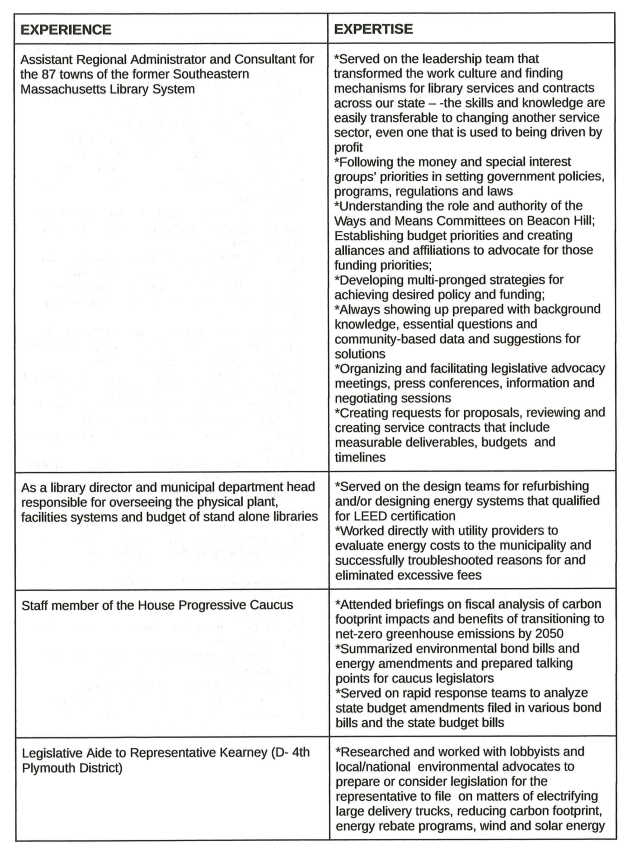
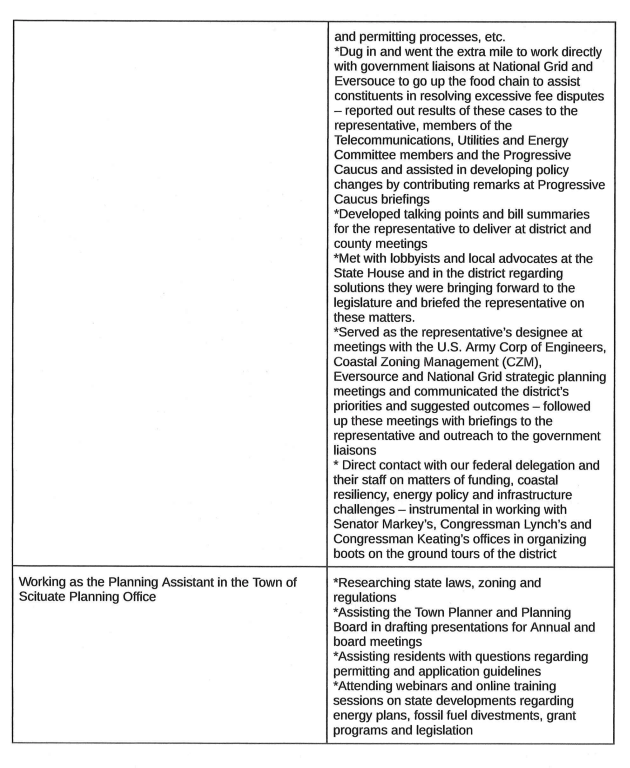
In New England we are combating the fossil fuel's resistance to transforming what has been the backbone of our energy economy for decades. Expecting an economic system to not only change but to deliver relief to ratepayers and cut excessive profits is an expectation fraught with controversy, special interests, non-compliance and delayed deadlines. Specific experience that has prepared me to become an expert lawmaker outfitted to combat the Fossil Fuel industry's firm hold on the energy sector includes:
c) What funding and legislative resources will you advocate for in order to combat the effects of ever increasing climate change, and how will you promote the expanded use of Clean Energy (wind and solar) in our district?
In these chaotic times of spur-of-the moment federal decisions to rescind state funding, walk backs on established policies and laws, shutdowns or layoffs I will be maintaining consistent contact with our federal delegation and their staff to provide ongoing updates on impacts of policy changes, withdrawal of federal funds, poor implementation of programs, etc. on our state and local budgets and implementation strategies. Always our district will be needing tools and grant opportunities from the state to move forward with our future resiliency plans and to manage and sustain what we've got. Massachusetts is a premiere education, research and economic partnership development state and, as such, totally gets the challenges of shifting the special interests and investment strategies of the fossil fuel industry on the entire investment, economic and social fabric of our communities. We at the local level need to be using the resources and relational expertise of our state representative's office to voice how we want the shift to happen and what the incentives and restorative measures will be. As your state representative I will work with town officials and local experts and advocates to support and grow: state adaptation grants to continue to leverage municipal vulnerability preparedness, the Federal Risk Management Act that will provide resources for local entities to secure climate data to be used in public construction projects; promote the state's access to the federal Climate Program Portal; and, work throughout the year with town officials and local advocates and the Plymouth County delegation to prepare budget and policy amendments to file within the Mass Ready Act environmental bond bill. My approach is to be an ongoing vanguard of dollars that we can be appropriating, collaborations we can be building and policies we can be implementing to promote and grow clean wind and solar energy. The legislators' current controversy over cutting funds to the Mass Save program which as led to layoffs in sustaining proven programs that enhanced residents' efforts to implement renewable energy resourcefulness sent a loud and clear message to our district that we need to be working together to direct Beacon Hill to put aside special interests and traditional problem-solving methods to work with municipalities to get us what we know we need to make our communities climate resilient. In the interest of the reader's time I am going to refer you back to the communication strategies I laid out in question 2 as an outline of my promotional strategies. I should say that I will also enlist the expertise of our local community cable stations. I have outlined a range of communication t In any position I have held I have made it a priority to keep my finger on the pulse of constituent concerns. Because of this I have learned to be inquisitive, persistent, bold and informed on many matters including those related to the energy and environmental concerns of this district. I look forward to working with community members, experts and officials to continue to strengthen my experience and knowledge in order to become the environmental policy champion this district needs on Beacon Hill.
I thank you for this opportunity to respond to your questions and have enjoyed seeing many of you in the district these past weeks. I respectfully ask for your vote on Tuesday, September 1st. Reach the Baxter Committee at info@katiefor4th.com or (339)-746-0349.
Thank you for participating in our democracy